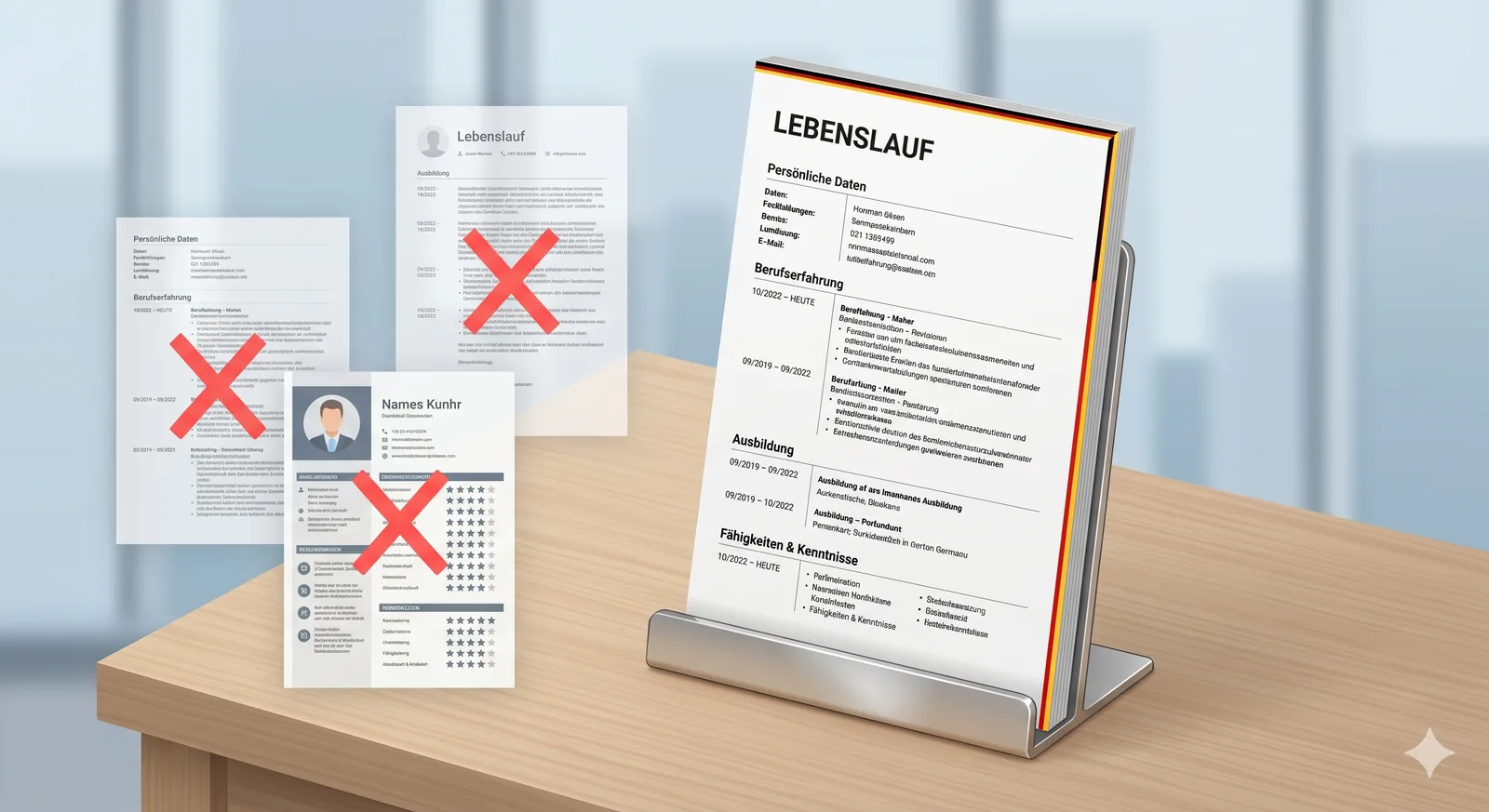
In the US, it's a "resume." In the UK, a "CV." In Germany, Austria, and Switzerland, it's a "tabellarischer Lebenslauf" — and that's not just a different name, it's a different format with different rules.
People applying from the English-speaking world to DACH make the most mistakes here. So do people applying within DACH using a US-built tool.
What "tabellarisch" actually means
"Tabellarisch" doesn't mean: in a table. That's the most common confusion.
"Tabellarisch" means: chronologically ordered, with dates on the left and position on the right, no flowing-text descriptions, no career-objective paragraph at the top like in a US resume. The structure is tabular in the arrangement, not in HTML tables.
That's an important distinction, because actual tables (Word tables, HTML <table>) are often misparsed by ATS systems. Building "tabellarisch" with tables breaks applications at Workday or SAP SuccessFactors before they reach a human.
The 2026 standard structure
In this order, no exceptions:
1. Personal details. Name, address, phone, email. Date and place of birth are conventional in DACH, voluntary under GDPR interpretation. Marital status and religion only if relevant for the role (rarely). Photo is convention but legally voluntary — more on that below.
2. Professional experience. Reverse chronological (most recent first). Per role: dates, employer, city, position, 3-5 bullets on tasks and achievements. Date format like "03/2022 – 09/2024" or "March 2022 – September 2024."
3. Education. Also reverse chronological. Drop high school only if you have more than 10 years of work experience or a university degree.
4. Continuing education and certificates. Sorted by relevance, not chronologically.
5. Languages. With CEFR level (A1-C2). No star ratings, no percentages — ATS systems only reliably parse the letter code.
6. Technical skills. Grouped (programming languages, frameworks, tools), not as one long list.
7. Additional items. Volunteer work, hobbies, publications — brief, only if relevant.
What doesn't belong: "Career objectives," generic "Personal strengths" lists, family details (unless asked), salary expectations.
Photo: yes or no?
The most contested element. In DACH, a professional application photo is still common but no longer required. The General Equal Treatment Act (AGG) has shifted the legal picture: employers can't demand a photo because it would enable discrimination.
Practically:
- Conservative employers (banks, insurance, mid-cap) often expect a photo. Omitting can cost points.
- Tech companies and international corporations increasingly don't care or actively prefer no photo (bias avoidance).
- If you use one: professional photo, not a vacation shot. Costs start at €80 at a local photographer.
If unsure: send without photo. The probability of a negative effect is lower than the effect of a bad photo.
The most common format mistakes
Two-column designs. Yes, they look modern. No, the ATS doesn't read them reliably. Skills end up under work experience, dates disappear.
Dates in table cells. Left column date, right column content — as a Word table. Looks clean, fails at Workday and SAP. Use fixed-width spacing or a tab stop instead.
Star ratings for languages or skills. "Excel ★★★★☆" reads clearly to humans but is an image or special character to the ATS. Write "Excel: advanced" or "Excel: daily use in reporting and pivot tables."
English titles in a German CV. "Bachelor of Science" is fine because it's the official degree designation. "Project Lead" as a self-chosen title instead of "Projektleiter" reads as inauthentic — except in English-speaking or tech environments.
Third page or longer. Rule of thumb: maximum two pages. Exception: over 15 years in the same field, with relevant depth. Three pages often signal "can't prioritize."
Where AI helps
For the tabellarischer Lebenslauf, it's less about creativity and more about consistent tailoring. AI can:
- Rephrase bullets so the central terms of the job posting are mirrored — without changing the meaning.
- Reorder bullets within each role to prioritize what's relevant for the specific job.
- Trim the profile summary (if used) to two or three precise sentences.
What AI must not do: change dates or employer names. Using a tool that does risks a discrepancy that surfaces in a reference check.
At RefactorCV employment dates and employer names are deterministically rewritten from the original after every AI generation. AI adapts the style. The facts stay.
A conservative summary
A good tabellarischer Lebenslauf in 2026 is: two pages, single column, reverse chronological, with clear headings and clean dates. Conservative design readable on both Workday and Personio. Photo optional. Bullets tailored to the role.
It's not original. It works.