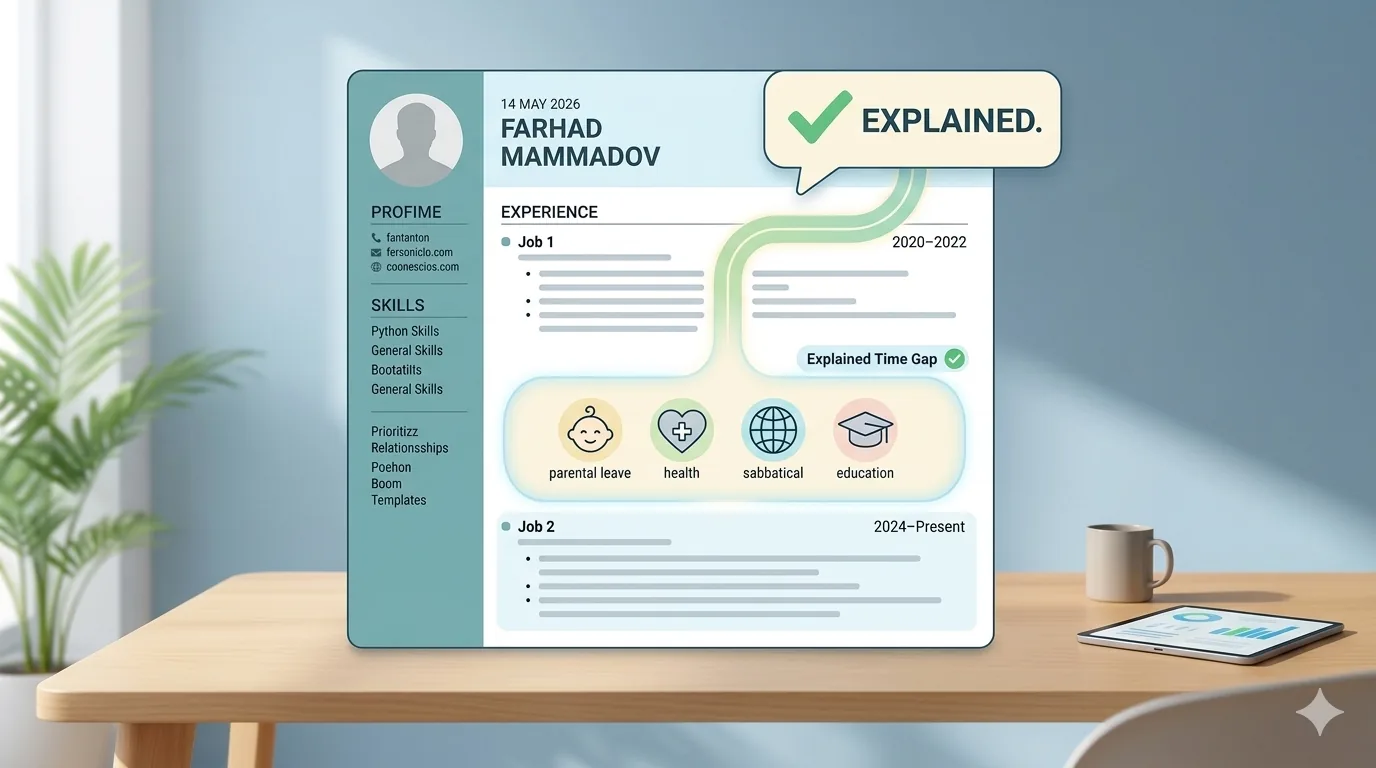
Gaps in CVs are one of the unspoken stress points of the European application process. Unlike in the US, where career breaks are increasingly normalized, in Germany and Switzerland the unspoken question still hangs in the air: "What were you actually doing?"
The good news: recruiters have shifted their tolerance dramatically in the last five years. The bad: certain phrasings still trigger immediate suspicion.
What recruiters actually want to see
When a recruiter sees a CV gap, they're not thinking "this person is lazy." They're thinking: "I don't know what happened here. If I don't know, I can't clarify it in the interview, and I'd rather give that slot to someone whose history is clear."
Most gaps aren't a disqualifier. They're an information gap. Your job is to fill that gap briefly and factually — before the recruiter constructs their own story.
The 9 phrasings that work
1. Parental leave / family phase
"Parental leave / family phase, [Month/Year – Month/Year]. Focused on [optionally: childcare, volunteer work, online further education in X]."
Parental leave is completely accepted in DACH. Important: name the time range clearly. If you did something relevant in that time (further education, role-related volunteering), mention it briefly. Otherwise don't.
2. Care for family members
"Family care leave, [period]. Full-time care for a family member."
Also accepted and usually triggers understanding. No details about the sick person — that's private.
3. Personal health leave
"Personal health leave, [period]. Fully recovered and back to full capacity since [month]."
Phrasing matters here. Not "burnout" or a specific diagnosis. Recruiters need the information that you're fit now — not the details of the illness.
4. Sabbatical / extended travel
"Sabbatical, [period]. Extended travel through [region], focused on [language, culture, personal development]."
A sabbatical is accepted if it sounds planned. An "around-the-world trip" of 18 months without context sounds aimless; "a nine-month sabbatical with a Spanish course in Mexico" sounds like a clear plan.
5. Further education / retraining
"Full-time further education in [X], [institution], [period]. Areas covered: [concrete]."
If the further education is relevant to the role, it's a plus, not a negative. If it was a reorientation, it can also be a plus — see career change.
6. Job search
"Active career reorientation, [period]. Focused on roles in [X]."
Honest, factual. That's all you need. A gap of 3-6 months of job searching is normal and no problem. For longer searches (over 9 months), recruiters usually expect additional explanation — what else happened.
7. Self-employment
"Self-employed as [role], [period]. Focus areas: [2-3 concrete projects or domains]."
Self-employment isn't a gap filler. It's professional experience. Treat it like an employed position — with tasks, achievements, possibly clients (anonymized or named, depending on confidentiality).
8. Unemployment after insolvency / layoff
"[Previous position], [Previous employer], [period]. Ended due to [insolvency / employer restructuring / layoff]."
If the termination came from the employer and not from you, say so. Insolvency and restructuring are understandable and don't disqualify anyone.
9. Volunteering
"Volunteer work at [organization], [period]. Responsibilities: [concrete]."
If you volunteered during the gap, treat it as a position. It shows you accomplished something in that time.
What triggers suspicion
Avoid these phrasings:
"Personal reasons" — too vague. Recruiters don't know if it was 3 weeks of breakup or 18 months of burnout, and will assume the worst.
No mention of the gap at all. You don't address it, and the CV shows a jump from 2019 to 2022. This is the worst option: it looks like you're hiding something.
Dressing up unemployment as "consulting." If you didn't actually consult (clients, projects, invoices), don't write it. In the interview, the question "Which projects?" will come, and it gets uncomfortable.
Overly positive self-presentation of the break. "A transformative phase of intensive personal development" sounds like an esoteric retreat. Stay factual.
Where does the gap go?
In a chronological CV, the gap belongs at its time position — with its own line, clear label, brief explanation. Don't hide it.
In the cover letter, you can mention it in one sentence if it obviously needs explanation. But: don't spend more than a line on it. The main body of the cover letter belongs to the role, not to the past.
The honest recommendation
Recruiters have seen thousands of CVs with gaps in recent years. Pandemic, care, burnout, parental leave, sabbaticals — this has become normal. What hasn't become normal is candidates who cover up or dress up their gaps.
A short, factual explanation closes the gap informatively and signals maturity. That's almost always better than any avoidance strategy.