In France, it's standard. In the US, it's taboo. In Germany, it's complicated.
The application photo is one of those topics where DACH convention and legal reality diverge. Most guides say "of course you include a photo" — and ignore that this has been legally outdated since the General Equal Treatment Act (AGG) of 2006.
What the law says
The AGG prohibits discrimination in hiring based on origin, age, gender, religion, disability, and sexual orientation. A photo makes all of those visible — and makes it easier for the employer to unconsciously (or consciously) discriminate.
Consequence: employers cannot require a photo. If a job posting says "complete application materials with photo," that's legally problematic. You can still send one — no one's forcing you to test the law — but you don't have to.
GDPR reinforces this: a photo is personal data. The employer needs a legal basis to store it. On rejection, the typical retention period is three to six months (to defend against AGG claims), after which it must be deleted — including from internal ATS systems.
When the photo helps you
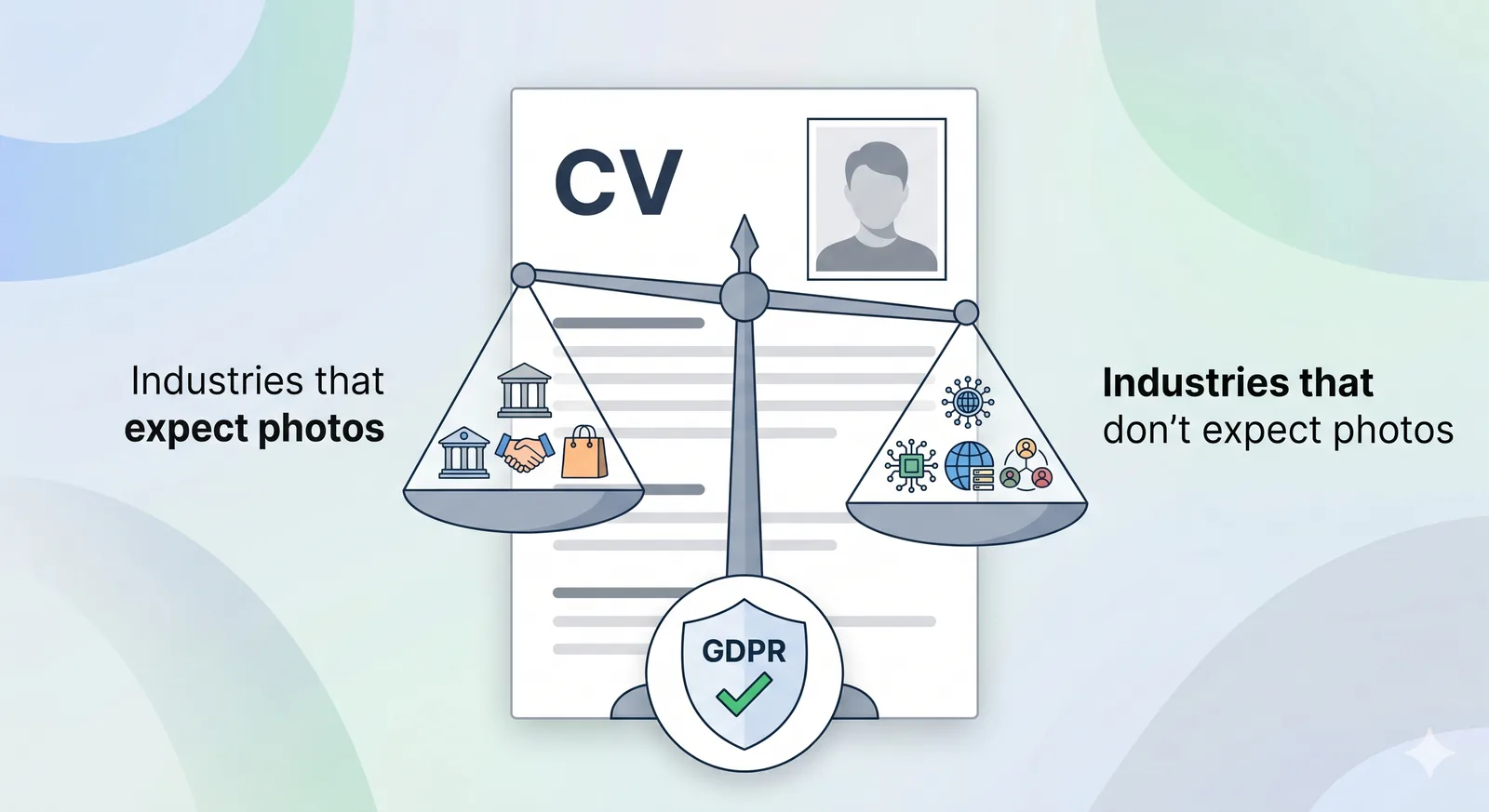
Despite the legal picture, there are industries where photos are practically expected and their absence costs points:
- Banks and insurance in the conservative mid-cap
- Sales and client-facing roles (field sales, consulting)
- Hospitality, gastronomy, retail with direct customer contact
- Family-owned mid-caps, especially in southern Germany and Austria
- Public service in some federal states
In these contexts, the photo signals: "I respect the convention." Its absence can be read as "foreign" or "not introduced" — even when that's irrational.
When the photo hurts you
Equally, there are contexts where a photo lowers your probability of an interview:
- Tech companies with anonymized application processes (increasingly standard at Berlin startups, software corporations)
- International corporations with US or UK headquarters (convention there is explicitly no photo)
- Diversity-oriented employers pursuing photo-free applications as best practice
- Specific discrimination risks for you: age over 50, migration background, religious clothing, visible disability — here a photo can trigger unconscious filters before the CV is read
For the last one, the effect is empirically documented: German studies for over 15 years have shown that applicants with German-sounding names and photos have higher interview rates than applicants with foreign-sounding names and photos — even with identical CVs. Anonymized applications (no name, photo, date of birth) drastically reduce this gap.
What a good application photo costs and is
If you choose to use a photo, it's worth having it done professionally.
Cost: €80-250 at a local photographer for a professional application shoot with 2-3 final images. AI-generated photos and filter apps deliver unprofessional results on closer inspection — six-fingered hands in the background, hollow eyes, uniform skin that looks rendered.
What works: Plain background (gray, white, or muted color). Business attire fitting the industry (tech ≠ bank ≠ sales). Direct gaze into camera. Slight smile, not grinning. Shoulders visible, not just face.
What doesn't work: Selfies. Cropped vacation photos. Wedding party photos. A photo from ten years ago that no longer matches. AI-generated avatars.
GDPR in practice
When you send the photo, you grant the employer permission to use it in the application process — implicitly through submission. After a rejection, it must be deleted, typically after three to six months.
If after 12 months you're still in a company's talent pool with your photo visible, you can request deletion under Art. 17 GDPR. The company must respond and delete.
In practice this works, but rarely smoothly. Some talent pools are maintained with old photos for years. Those who want to be sure don't send the photo in the first place.
The honest recommendation
If you're freshly applying by DACH convention and you're in one of the photo-affine industries above: send a professional photo. It costs €100 and is usable for a few years.
If you're applying to tech, international corporations, or diversity-oriented organizations: leave it off. The probability of a positive effect is low, the probability of neutral or slightly negative is real.
If you're unsure: leave it off. The absence of a photo never disqualifies you. The presence of a bad or unsuitable photo can.