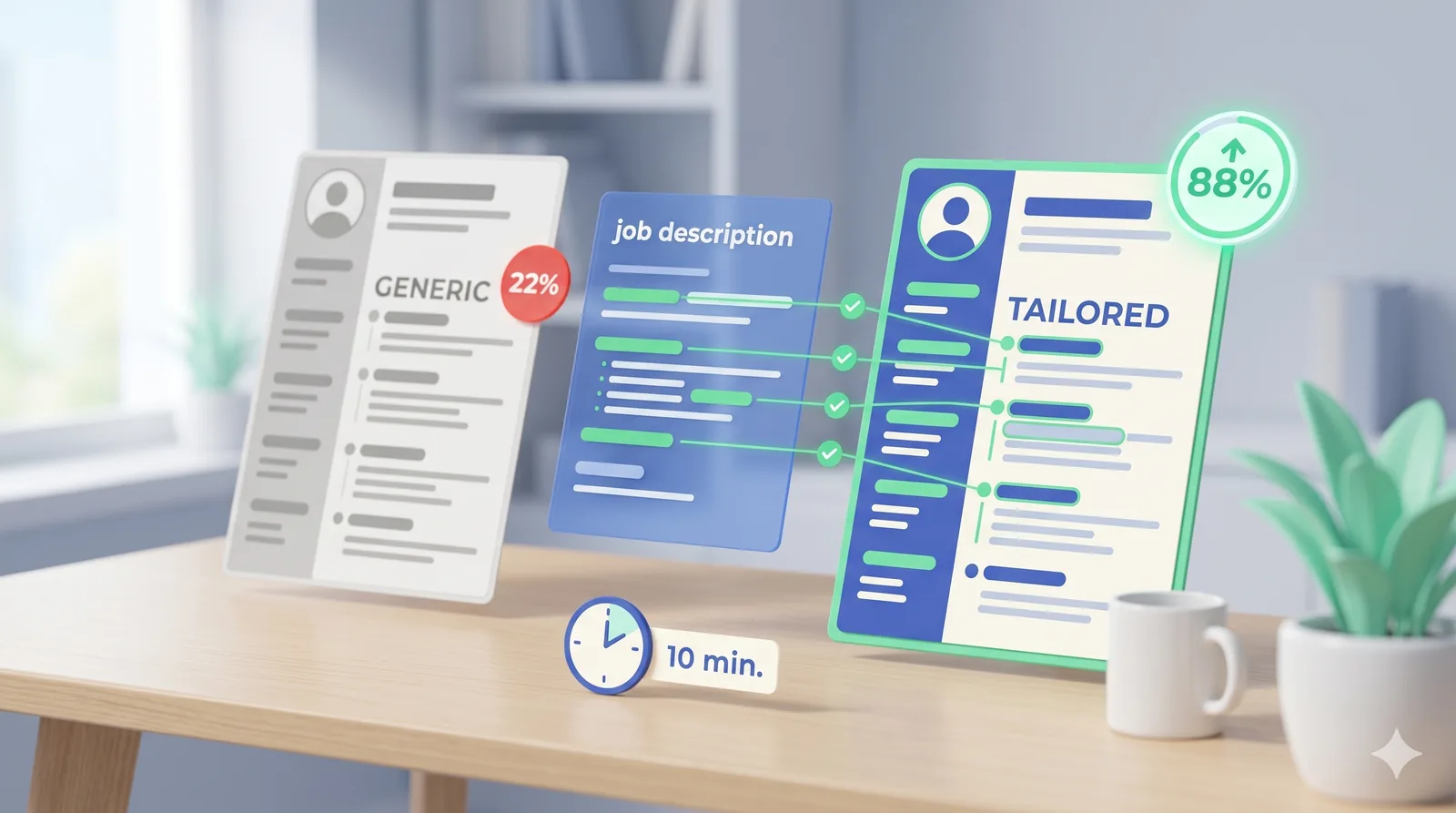
You read the job description for the third time. It's a fit — mostly. But your current CV doesn't feel quite right. It's good. It's just not good for this role.
That's the actual problem behind most candidates' low reply rates: not a bad CV, just a generic one. Recruiters spend the first 7 seconds looking for three things — matching terms, recognizable wins, and a sense that you thought about this role. A generic CV never delivers the third one.
The 5-step method
1. Read the job posting backward. The most important terms sit at the bottom — under "Requirements" and "Nice to have." Write out 12-25 concrete terms: tools, methods, soft skills, required years of experience.
2. Compare honestly. Do you actually have the experience? Then keep it. Have related experience under a different name? Rephrase it precisely. Don't have it? Leave it out. Never invent.
3. Mirror the language. If the posting says "data analysis" and you wrote "reporting," a human reads them the same — the ATS doesn't. Adopt the central terms in your summary and the first two bullets of each role.
4. Reorder achievements. Recruiters read only the first two bullets per role with attention. The most relevant achievements for this role belong at the top — not the chronologically biggest.
5. Adapt the header. Profile summary and job title are the first words anyone reads. Rewrite them for every application. If you only change one thing, change this.
The three most common mistakes
Too many adjustments at once. Stuffing every term from the posting into every bullet sounds stilted. Focus on 8-12 central terms.
Inflating experience. Writing "Python experience" after an online course is legitimate. "5 years of Python" after 18 months is a lie. It collapses in the interview, and you burn the relationship.
Adjusting dates or employer names. Never. If an AI tool changes these, the tool is broken.
When AI helps
The manual method takes 30-60 minutes per application. For 20 applications, that's 10+ hours before you've written your first cover letter.
AI removes that time — but only if the tool actually follows the steps above instead of skipping them. Concretely: it shows you every suggestion and you decide whether to accept, edit, or reject it. That's not just good product design; it's a requirement from Article 14 of the EU AI Act, which takes full effect on 2 August 2026.
At RefactorCV it also means: employment dates and employer names are deterministically rewritten from your original document after every AI generation. The AI adapts the style. It cannot invent the facts.
When it's not worth it
If the posting is generic, the role is no stretch for you, or you're applying to volume roles where everyone gets called — send the standard CV and save the time.
For every role you actually want, tailoring isn't optional. It's the only lever a single candidate has against 200 others.