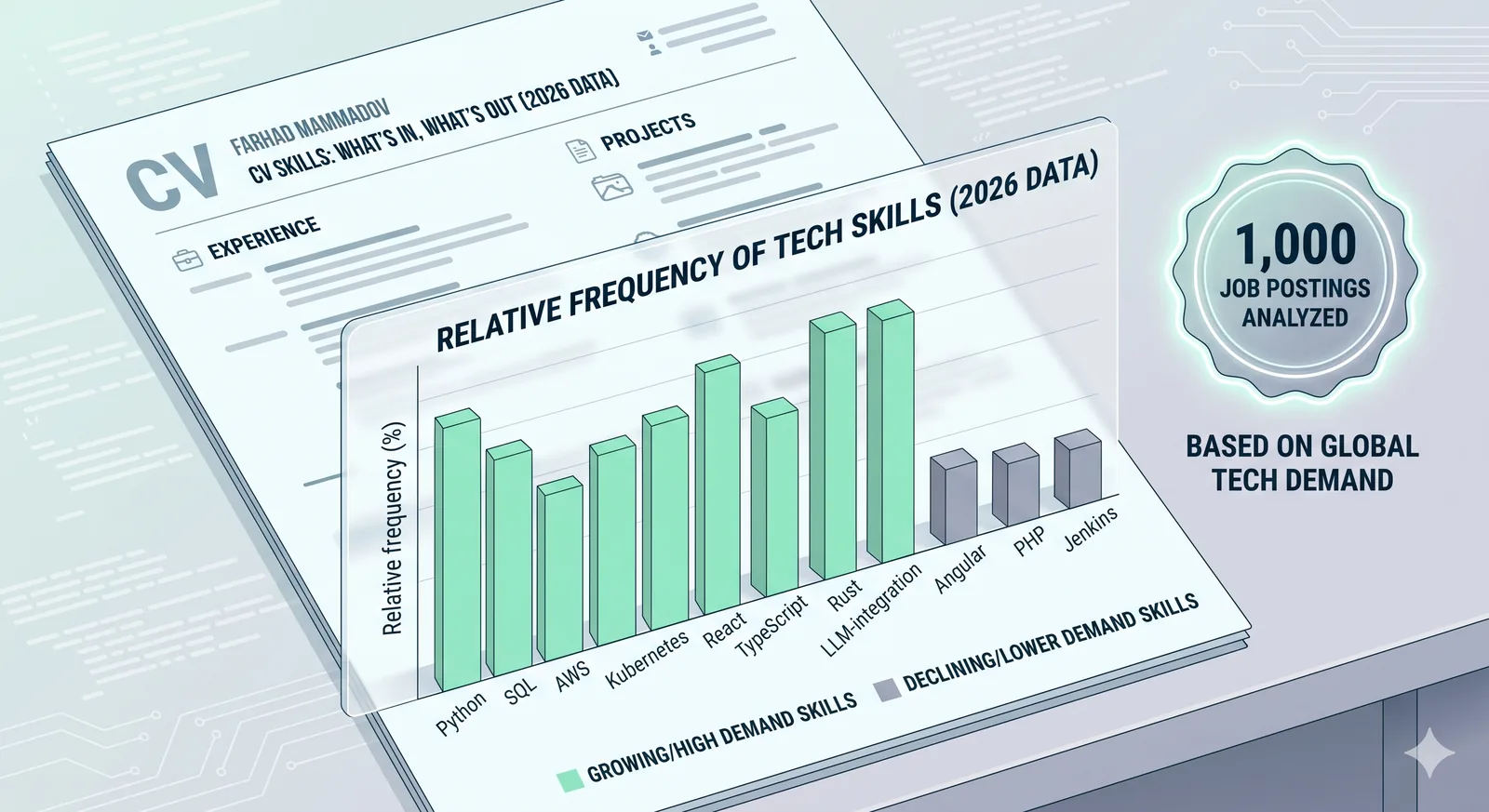
There are countless lists of "skills you need in 2026." Most are aggregated LinkedIn bullshit posts or marketing material from bootcamps. We looked at the numbers ourselves: 1,000 IT job postings from Germany, Q1 2026, from mid-cap to DAX-40.
What we found differs in several points significantly from what the LinkedIn skill lists claim.
What's mentioned far more than most think
Cloud platforms — but specifically. "Cloud experience" alone appears in 41% of postings. But 31% explicitly name AWS, 22% Azure, 9% Google Cloud. If "Cloud" is in your CV without the specific platform, you fall under the ATS radar.
Kubernetes. Explicitly named in 28% of DevOps and platform engineering roles. "Container orchestration" without specifying Kubernetes isn't matched by the ATS.
Python for data roles. Named in 73% of data engineering and data science roles. R now appears in only 11% — five years ago it was nearly standard.
SQL. 64% of all data roles, but also 38% of all backend roles. SQL is the most underrated skill on IT CVs. If you have SQL experience, list it explicitly.
GDPR knowledge. Explicitly mentioned in 19% of all roles — especially in mid-cap and regulated industries (banking, insurance, healthcare). A growing requirement, often not seen as a technical skill.
What's dropping out
Angular and Vue — in frontend roles, declining for two years. React dominates at 47% vs. Angular 18% and Vue 9%. If your CV highlights Angular but you apply to React roles, you lose matches.
PHP — surprisingly down. Only 8% of all backend roles, mostly at smaller agencies and mid-caps with legacy systems.
Jenkins — increasingly displaced by GitHub Actions, GitLab CI, and ArgoCD. Jenkins still appears in 14% of DevOps roles, but usually as "nice to have" rather than required.
TypeScript? No, that hasn't dropped. TypeScript is named in 71% of all frontend roles. Writing only plain JavaScript will get increasingly harder in the DACH market.
What's appearing as new
LLM integration — explicitly mentioned in 14% of all backend roles in 2026, was under 3% in early 2025. Terms like "RAG," "Vector Databases" (Pinecone, Weaviate, pgvector), "OpenAI API," "Anthropic API," "LangChain" suddenly appear in regular engineering postings, not just ML roles.
Rust — grown from 4% to 9%. Especially in systems engineering, backend, and security-critical domains. Not mainstream yet, but growing fast.
Privacy engineering and EU AI Act knowledge — in 6% of roles, six months ago under 1%. Anyone with experience here (DPIA, Privacy by Design, AI Act compliance) can position strongly for 2026/2027.
ESG and sustainability tools — named in 4% of backend and data roles. Specific to companies with ESG reporting obligations (CSRD).
Soft skills actually mentioned
"Communication skills" appears in 78% of all postings — but that's filler level. More meaningful:
- Independent work (54%)
- Cross-functional collaboration (42%, almost always in tech roles)
- Stakeholder management (38%, often engineering-to-product or engineering-to-sales translation)
- English at C1 or business-fluent (61%)
- Self-directed prioritization (33%, especially in senior roles)
"Team player" alone means nothing. If you have it on your CV, replace it with concrete examples.
What this concretely means for your CV
Three steps based on the data:
1. Concrete tools instead of categories. "Cloud" → "AWS (EC2, S3, Lambda)." "DevOps" → "Kubernetes, GitLab CI, Terraform." "Frontend" → "React, TypeScript, Next.js." The ATS searches for tokens, not categories.
2. Check outdated tools against role focus. If you list Angular or Vue on your CV and apply to React roles, you drop out. If you list Jenkins and they want GitHub Actions, same. Tailor to the role; don't hope someone makes the translation for you.
3. Mention LLM experience if you have it. Even small projects: a RAG prototype in a hackathon, an integration into your backend, an eval setup. This is becoming a differentiator because few candidates honestly list it on their CV yet.
What the data doesn't show
Job postings aren't reality. They're what recruiters wrote down, often with the ambition of describing "the perfect candidate" — whom no one reaches. The skill lists are often longer than what's actually needed.
What really counts you learn in the interview. But to get to the interview, you first have to convince the algorithm and the recruiter. And both look for the tokens listed here.