The question comes up in every applicant community, usually late at night, always with a little guilt: "If I use ChatGPT to rephrase things — will the recruiter notice?"
Honest answers are rare. Instead, there are two camps: "Never, AI is invisible!" and "Always, it's spotted instantly!" Both are wrong. Both oversimplify.
What's actually detected
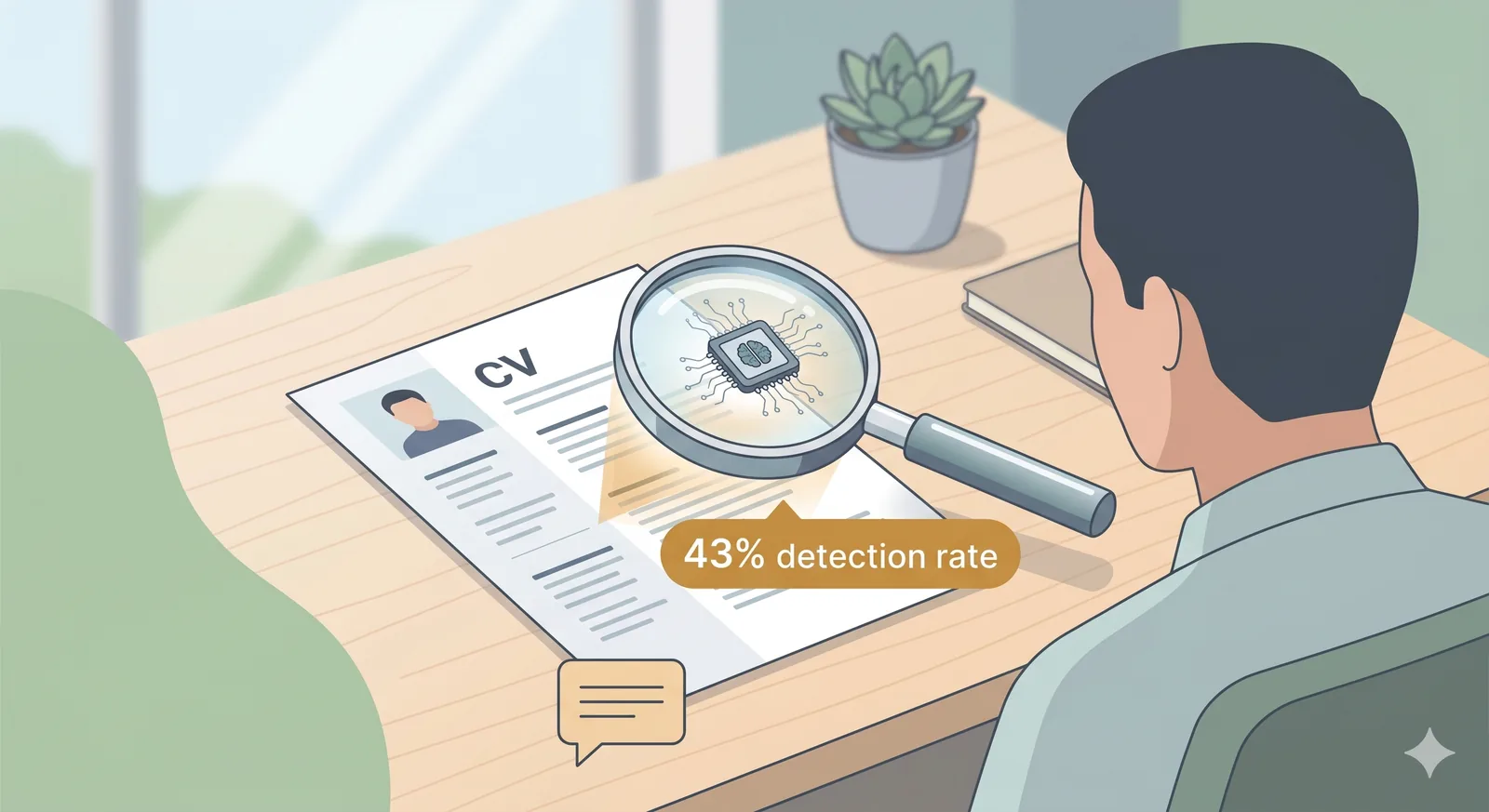
A 2026 SHRM study shows: 43% of larger employers in Germany and the US use automated AI detection on applications. Tools like GPTZero and Originality.ai are integrated into HR pipelines. 49% of those employers automatically reject applications flagged as AI-generated.
That sounds brutal. It's also significantly less clear-cut than the numbers suggest.
First: AI detection tools have false-positive rates between 10 and 20 percent. A Stanford study found that 61% of texts written by non-native English speakers were incorrectly classified as "AI-generated" — entirely hand-written, just in non-perfect English. If your English or German isn't native, you've very likely already received false flags without knowing.
Second: detection tools work via statistical patterns. Very smooth, even sentences. Certain ChatGPT-typical phrasings ("Furthermore," "It is worth noting," "In today's fast-paced world"). If you avoid these patterns — which happens when you use AI only to rephrase your own sentences — detection drops sharply.
When AI in an application isn't a problem
Three use cases that stay inconspicuous in most cases:
Rephrasing your own bullets. You did the work. You're just describing it more clearly. That's legitimate and standard — professional career coaches would do exactly this without AI.
Tailoring to a job description. You emphasize the aspects of your experience that are relevant for this role. AI helps you see faster which terms should be mirrored.
Structuring and editing. Bringing longer texts (cover letter, profile summary) into a clearer structure, removing repetition, catching typos.
All three have one thing in common: the facts come from the candidate, the AI adjusts the form. That's exactly what professional editing has done for decades.
When it goes wrong
Three use cases where it becomes a problem:
Inventing experience. You never did a Python project, but the AI-generated CV claims you completed one. That falls apart in the first technical interview question — with or without AI detection.
Inflating responsibility. "Led a team of 5" instead of "Worked in a team of 5." Subtle, but easily uncovered in a reference check or by an experienced recruiter.
Complete rewriting without your own voice. The whole CV reads as generic AI language: "Spearheaded transformative initiatives," "Leveraged cross-functional synergies," "Delivered impactful results." Statistically detectable and reads as dead to human readers.
The honest recommendation
AI is a tool for tailoring and refining — not for creating from nothing. Used that way, it goes unnoticed in the vast majority of cases. And where it is detected, the consequence is rarely as dramatic as feared, because the detection tools themselves are too unreliable to be used as a sole filter.
If a company explicitly asks whether you used AI, the only reasonable answer is: yes, for structure and phrasing, and the substance is mine. That's exactly what professional CV coaching does — no one would call that "deception."
What we're building so you don't have to guess
At RefactorCV we're building an Authenticity Check that scans your own document for typical AI patterns before you submit. Not to help you evade detection. So you can see for yourself where your CV reads too generic — and sharpen it with your own voice.
Sounds like you. Not like AI. That's the only sustainable strategy.